KesimptaConnect
Dedicated, personalised support for KESIMPTA patients.
This page is intended for UK healthcare professionals and other relevant decision makers only. If you are a member of the public, please click here.
This portal is funded and owned by Novartis Pharmaceuticals UK Ltd and includes content approved by Novartis.
Adverse events reporting information can be found in the footer of this page.

Prescribing information (external link)
KESIMPTA is indicated for the treatment of adult patients with relapsing forms of multiple sclerosis (RMS) with active disease defined by clinical or imaging features.1
All patient imagery on this webpage is fictional and used for illustrative purposes only.
Women of childbearing potential should use effective contraception (methods that result in less than 1% pregnancy rates) while receiving KESIMPTA and for 2 months after the last administration.1
For full safety information, please refer to the KESIMPTA® Summary of Product Characteristics (SmPC).1 Learn more about the KESIMPTA safety profile.
KESIMPTA is the first fully human B-cell targeting monoclonal antibody (mAb) in active RMS.1,2 KESIMPTA preferentially targets B-cells in lymph nodes with less delivered to the spleen, which may help preserve immunoglobulin G (IgG) levels (data from animal models).1,3–5 Watch the short video below to learn more.
The precise mechanism by which KESIMPTA exerts its therapeutic effects is unknown. The clinical relevance of these data are unknown.
MS is a complex, autoimmune condition defined by inflammation, demyelination and axonal damage in the central nervous system (CNS). This damage is caused by B-cells within the lymph nodes, which capture auto-antigens from neurons or their myelin sheaths and, upon presentation to T-cells, direct them to attack the body’s CNS tissue.6,7
To learn more about the pathogenesis of MS and the role of B-cells in the disease, watch this short video.
To learn about how KESIMPTA targets B-cell subsets that facilitate inflammation, and how it causes CD20-inducing lysis of these B-cells, watch this short video.1
KESIMPTA is the first fully human B-cell targeting mAb in active RMS1,2
KESIMPTA has been shown to act on B-cells in MS patients, targeting them and inducing cell lysis1
KESIMPTA is an anti-CD20 monoclonal IgG1 antibody that acts on the immune system, by selectively targeting and binding to the CD20 protein.1 This protein is expressed on the surface of the majority of B-cells, making it a valuable target for precise MS treatment.8 KESIMPTA is thought to work by selectively binding to sites on both the small and the large extracellular loops of CD20 protein on B-cells8–10
The precise MoA by which KESIMPTA exerts its therapeutic effects is unknown.
KESIMPTA dosing was designed to sustain B-cell depletion with a generally favourable benefit–risk balance.11–13
To find a generally favourable benefit–risk balance, the recommended 20 mg dose of KESIMPTA was carefully selected through dose modelling based on B-cell depletion and Phase II data, which concluded that once-monthly 20 mg subcutaneous (SC) dosing was comparably effective with generally fewer side effects than higher SC doses.11–13
Initial dosing starts at Weeks 0, 1 and 2, followed by subsequent monthly dosing starting at Week 4.1
Induced lysis of CD20+ B-cells results in depletion through complement-dependent cytotoxicity (CDC) and antibody-dependent cellular cytotoxicity (ADCC). KESIMPTA has been shown to induce target cell death in both high and low CD20-expressing cells.1
The selective MoA and precise delivery arising from the SC MoA enables preferential depletion of B-cells in the lymph nodes. The preservation of B-cells in the spleen, as demonstrated by preclinical evidence, may contribute to immune function.3–5
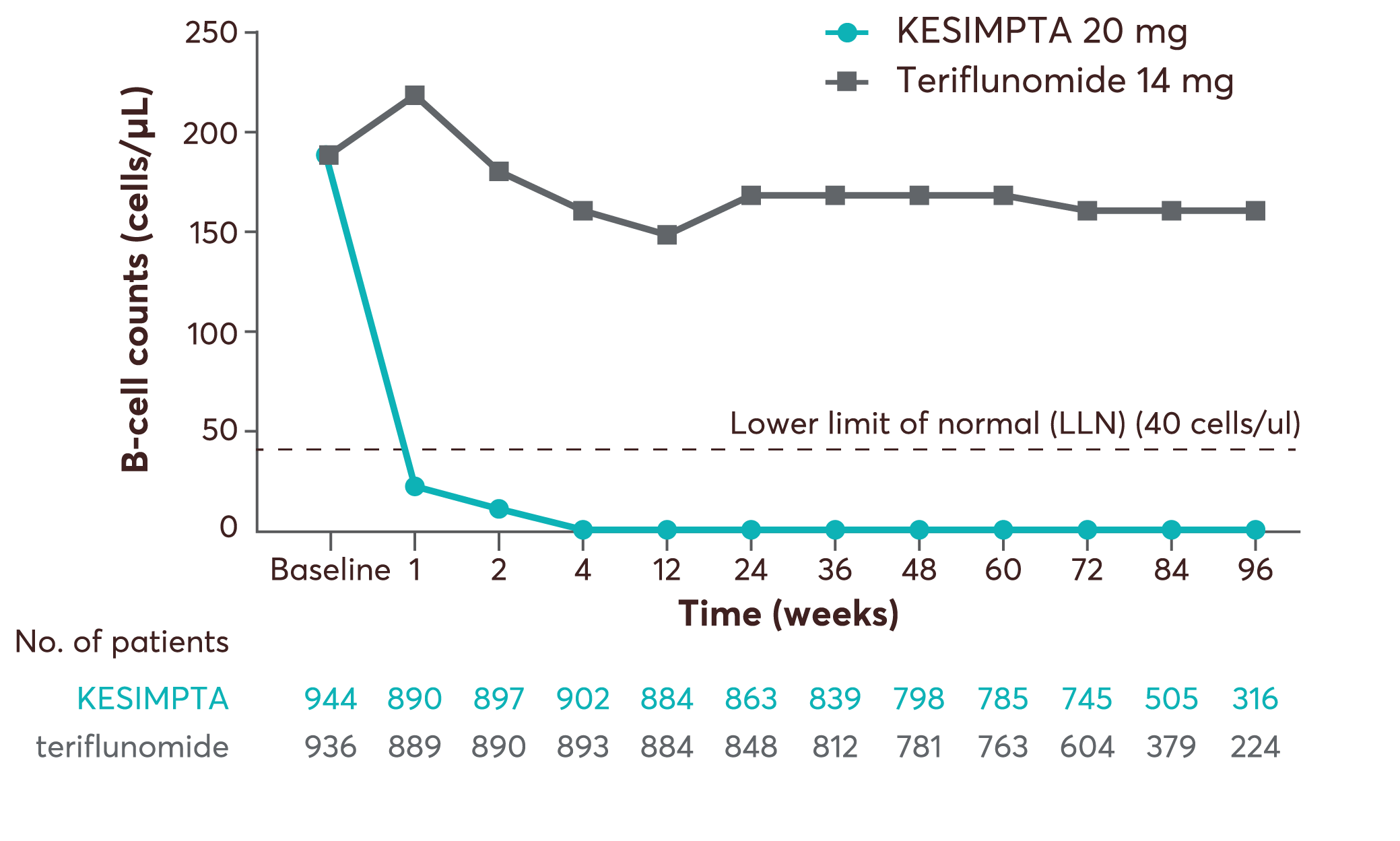
Adapted from Hauser SL, et al. 2020.14
In the RMS clinical studies using KESIMPTA 20 mg every 4 weeks, after an initial dose regimen of 20 mg on Days 1, 7, and 14, administration resulted in a rapid (by Week 1) and sustained reduction of B-cells to below LLN (defined as 40 cells/µL) as early as two weeks after treatment initiation. Before initiation of the maintenance phase starting at Week 4, total B-cell levels of <10 cells/µL were reached in 94% of patients, increasing to 98% of patients at Week 12, and were sustained for as long as 120 weeks (i.e. while on study treatment).1
ASCLEPIOS I and II were Phase III, randomised, double-blind, double-dummy, active comparator-controller, parallel-group, multicentre trials (n=1882). Patients were randomly assigned to receive either subcutaneous KESIMPTA (20 mg every 4 weeks after 20 mg loading doses at Day 1, 7 and 14) or oral teriflunomide (14 mg daily). The primary endpoint was annualised relapse rate.15
83.6% (n=791/946) in the KESIMPTA group vs 84.2% (n=788/936) in the teriflunomide group reported an adverse event (AE) in the combined ASCLEPIOS I/II trials. AEs that occurred in at least 10% of the patients treated with KESIMPTA were injection-related reactions, nasopharyngitis, headache, injection-site reaction, upper respiratory tract infection, and urinary tract infection; AEs that occurred in at least 10% of those treated with teriflunomide were nasopharyngitis, injection-related reactions, alopecia, upper respiratory tract infection, headache, and diarrhea.15
In the event of treatment discontinuation, B-cell repletion has also been studied in predictive models.1
Adapted from Yu H, et al. 2022.16
PK B-cell modelling and simulation for B-cell repletion corroborate these data, predicting a median time to B-cell recovery to LLN (40 cells/μL) of 23 weeks post-treatment discontinuation.1

*Based on pharmacokinetic B-cell modelling (B-cell model: An indirect response model to describe the stimulation of B-cell lysis by free ofatumumab concentrations) of B-cell counts from 1486 patients with SC KESIMPTA administration and 25 patients with intravenous KESIMPTA administration across 5 pooled studies (MIRROR, OMS115102, ASCLEPIOS I & II and APLIOS). Simulation is for SC route with pre-filled syringe and using Phase Ill dosage regimen.16 KESIMPTA is not licensed for intravenous administration; please see the SmPC for more details.
ADCC, antibody-dependent cellular cytotoxicity; AE, adverse event; CD, cluster of differentiation; CDC, complement-dependent cytotoxicity; CNS, central nervous system; HCP, healthcare professional; IgG, immunoglobulin G; LLN, lower limit of normal; mAb, monoclonal antibody; MoA, mechanism of action; MS, multiple sclerosis; PK, pharmacokinetics; RMS, relapsing multiple sclerosis; SC, subcutaneous; SmPC, summary of product characteristics.
References
KESIMPTA (ofatumumab) Summary of Product Characteristics.
Hauser SL, et al. Neurol Ther 2023;12(5):1491–1515.
Theil D, et al. Front lmmunol 2019;10:1340.
Huck C, et al. J Neuroimmune Pharmacol 2019;14(4):709–719.
Torres JB, et al. Front Immunol 2022;13:814064.
Pender MP, et al. Curr Allergy Asthma Rep 2007;(4):285–292.
Archelos JJ, et al. Ann Neurol 2000;47:694–706.
Zhang B. mAbs 2009;1(4):326–331.
Gupta IV & Jewell RC. Ann N Y Acad Sci 2012;1263:43–56.
Martin R, et al. Eur J Immunol 2016;46:2078–2090.
Sorensen PS, et al. Neurology 2014;82:573–581.
Bar-Or A, et al. Neurology 2018;90:e1805–e1814.
Savelieva M, et al. Poster P5.348. American Academy of Neurology (AAN). 22–28 April 2017, Boston, MA.
Hauser SL, et al. Poster P7.1-013. American Academy of Neurology (AAN). 25 April–1 May 2020.
Hauser SL et al N Engl J Med 2020;383(6):546–557.
Yu H, et al. CNS Drugs 2022;36(3):283–300.
Novartis Data on File. Ofatumumab (OFA22). June 2024.
UK | August 2026 | FA-11673031-1
Adverse events should be reported. Reporting forms and information can be found at www.mhra.gov.uk/yellowcard. Adverse events should also be reported to Novartis online through the pharmacovigilance intake (PVI) tool at www.novartis.com/report, or alternatively email [email protected] or call 01276 698370.
*Other relevant decision makers particularly includes those with an NHS role who could influence in any way the administration, consumption, prescription, purchase, recommendation, sale, supply or use of any medicine but who are not health professionals.
This website is designed to be viewed on desktop.