Prescribing information (external link)


FABHALTA®▼ (iptacopan) is indicated as monotherapy in the treatment of adult patients with paroxysmal nocturnal haemoglobinuria (PNH) who have haemolytic anaemia.1
FABHALTA® efficacy and safety profile
The efficacy and safety of FABHALTA® in adult patients with PNH were evaluated in two multicentre, open-label, 24-week Phase III studies: an active comparator-controlled study (APPLY-PNH) and a single-arm study (APPOINT-PNH).1–3
APPLY-PNH (treatment-experienced)
APPLY-PNH study design
APPLY-PNH was a 24-week multicentre, randomised, open-label Phase III study designed to investigate the efficacy and safety of FABHALTA® in treating patients with PNH who continued to experience anaemia despite anti-C5 antibody treatment.1–3

Adapted from Peffault de Latour R, et al. 2024.3
Primary endpoints3 | Secondary endpoints3 |
Efficacy was based on two primary endpoints to demonstrate superiority of FABHALTA® to anti-C5 in achieving haematological response after 24 weeks of treatment, without a need for transfusion, by assessing:
|
|
*Eculizumab or ravulizumab.1–3
†n=1 discontinued due to pregnancy.1,4
‡n=1 did not enter extension period; investigator decision.3
§Assessed between Days 126 and 168.3
¶Between Days 14 and 168 and neither meeting the criteria for administration of an RBC transfusion nor receiving an RBC transfusion between Days 14 and 168.3
‖Excluding values within 30 days of RBC transfusion.1
**Throughout the study.3
Hb improvement
Primary endpoints
Evaluation of efficacy was based on two primary endpoints related to the proportion of participants achieving a haematological response after 24 weeks of treatment (assessed between Days 126 and 168), without a need for RBC transfusion:1,3
Increase from baseline in Hb level by ≥2 g/dL*
Hb normalisation (Hb ≥12 g/dL) rate
Response rate of patients achieving a sustained increase of Hb levels ≥2 g/dL from baseline

Adapted from FABHALTA® Summary of Product Characteristics and Peffault de Latour R, et al. 2024.1,3
Response rate of patients achieving a sustained Hb level ≥12 g/dL
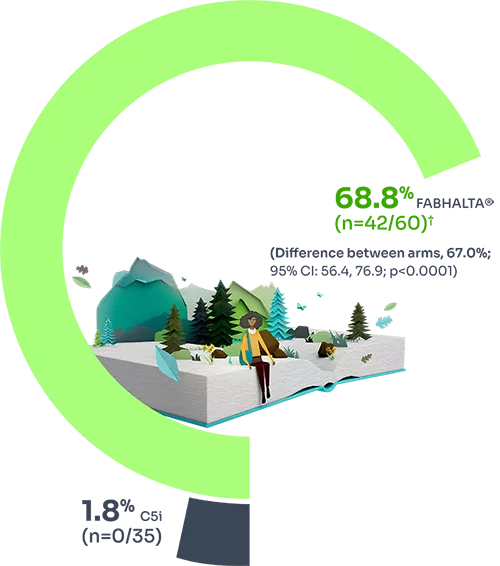
Adapted from FABHALTA® Summary of Product Characteristics and Peffault de Latour R, et al. 2024.1,3
*Assessed between Days 126 and 168. Estimated proportions of patients were calculated to reflect the population average probability of a patient meeting the endpoint criteria.3
†Based on observed data among evaluable patients. In 2 patients with partially missing central Hb data between Days 126 and 168, the haematological response could not be established unequivocally. The haematological response was derived using multiple imputation. These patients did not discontinue.1,3
Transfusion avoidance
Secondary endpoint: transfusion avoidance1
Transfusion avoidance may be achieved with FABHALTA®.1
More patients achieved transfusion avoidance with FABHALTA® vs C5i (94.8% [n=59/62]* vs 25.9% [n=14/35];* difference between arms: 68.9%; 95% CI: 51.4 to 83.9; p<0.0001).1
Transfusion avoidance rate achieved by Week 24†1
![Graphic showing that more patients achieved transfusion avoidance with FABHALTA® vs c5i (94.8& [n=59/62] vs 25.9% [n=14/35]; difference between arms: 68.9%; 95% Cl: 51.4 to 83.9; p<0.0001) at week 24.¹](/uk-en/sites/pro_novartis_com_uk/files/styles/oneup_layout_desktop_2220/public/2026-06/fabhalta-transfusion-avoidance-graphic-a_v2.png.webp?itok=7zgSFn5O "Graphic showing that more patients achieved transfusion avoidance with FABHALTA® vs c5i (94.8& [n=59/62] vs 25.9% [n=14/35]; difference between arms: 68.9%; 95% Cl: 51.4 to 83.9; p<0.0001) at week 24.¹")
48-week data: transfusion avoidance4
Transfusion avoidance rates observed at Week 24 were maintained with FABHALTA® up to Week 48, with benefit also observed after switching from C5i at Week 24.‡4
>90% of patients in the FABHALTA® and C5i-FABHALTA® arms were observed to avoid RBC transfusions by Week 48.§4
Observed percentage of patients who avoided RBC transfusion†‡¶4
![Graphic showing that more patients achieved transfusion avoidance with FABHALTA® vs c5i by week 48 (91.9% [n=57/62] vs 94.1% [n=32/34].4](/uk-en/sites/pro_novartis_com_uk/files/styles/oneup_layout_desktop_2220/public/2026-06/fabhalta-transfusion-avoidance-graphic-b_v2.png.webp?itok=sXIPPz_z "Graphic showing that more patients achieved transfusion avoidance with FABHALTA® vs c5i by week 48 (91.9% [n=57/62] vs 94.1% [n=32/34].4")
*Based on observed data among evaluable patients. In 2 patients with partially missing central Hb data between Days 126 and 168, the haematological response could not be established unequivocally. The haematological response was derived using multiple imputation. These patients did not discontinue.1
†Transfusion independence is defined as absence of administration of packed-RBC transfusions or meeting the criteria for transfusion between Days 14 and 168.1
‡Assessment of transfusion avoidance did not include the first 2 weeks after initiation of FABHALTA® monotherapy.4
§Defined as neither receiving nor meeting the criteria for administration of an RBC transfusion.4
¶The patient numbers are observed data, and the percentages were calculated directly from these (i.e. these are descriptive statistics, not estimated proportions as were used in the primary 24-week analysis).4
Hb over time
Secondary endpoint: change from baseline in Hb levels3
With FABHALTA®, increases in Hb were observed as early as Week 2 and sustained for 24 weeks vs C5i.3
Mean Hb levels from baseline to Week 24*3

Adapted from Peffault de Latour R, et al. 2024.3
48-week data: change from baseline in Hb levels4
Hb levels were maintained to Week 48 in the FABHALTA® arm and a level of 12 g/dL was achieved by Week 28 in the treatment switch arm.4
Treatment arm | ||
Change from baseline in Hb (g/dL)† | FABHALTA® | C5i-FABHALTA® |
Adjusted mean change from baseline at Week 48 (95% CI) | +3.35 (3.04, 3.67) | +3.36 (2.94, 3.79) |
Adjusted mean difference in change from baseline (95% CI): Week 48 vs Week 24 | −0.41 (−0.80, −0.01) | +3.02 (2.49, 3.56) |
Table adapted from Risitano AM, et al. 2023.4
C5i to FABHALTA® switch

Adapted from Risitano AM, 2023.4
*Includes values within 30 days of RBC transfusion. 3/62 patients in the FABHALTA® arm and 21/35 patients in the C5i arm had RBC transfusions between Days 14 and 168.3
†Change from baseline was analysed using a mixed model of repeated measures that adjusted for covariates, including baseline Hb. Analysis includes all central laboratory Hb data, including post-transfusion data.4
‡Includes post-transfusion data.4
§At Week 25, Hb data were only available for one patient in the FABHALTA® arm (Hb level: 13.9 g/dL); this was not a scheduled visit in the protocol for the FABHALTA® arm but was for the C5i-FABHALTA® arm. The value in the FABHALTA® arm is not plotted on the graph as one patient cannot be representative of the whole treatment group.4
Fatigue
Secondary endpoint: FACIT-Fatigue scores3
FABHALTA® significantly improves FACIT-Fatigue scores to near-normal vs C5i.3
Mean FACIT-Fatigue scores over 24 weeks*3

Adapted from Peffault de Latour R, et al. 2024.3
(Adjusted mean change from baseline FABHALTA® +8.6; 95% CI: 6.7, 10.5; C5i +0.3; 95% CI: -2.2, 2.8; difference between arms +8.29; 95% CI: 5.28, 11.29; p<0.0001).‡1,3
48-week data: FACIT-Fatigue scores4
A reduction in patient-reported fatigue was achieved within 4 weeks in patients who switched from C5i to FABHALTA®.4
Treatment arm | ||
Change from baseline in FACIT-Fatigue score§ | FABHALTA® | C5i-FABHALTA® |
Adjusted mean change from baseline at Week 48 (95% CI) | +9.80 (8.04, 11.56) | +10.96 (8.58, 13.34) |
Adjusted mean difference in change from baseline (95% CI): Week 48 vs Week 24 | +0.73 (−1.14, 2.60) | +10.79 (8.12, 13.47) |
Table adapted from Risitano AM, et al. 2023.4
C5i to FABHALTA® switch

Adapted from Risitano AM, et al. 2023.4
*The Functional Assessment of Chronic Illness Therapy Fatigue (FACIT-F) is a patient-reported measure that assesses fatigue and its impact upon daily activities and function. Scores on the FACIT-Fatigue scale range from 0 to 52, with 0 being the worst possible score and 52 being the best possible score indicating no fatigue.5
†Determined through the assessment of 1010 adults in the US in the 1990s and 2426 adults in Germany in 2015.5
‡Adjusted mean assessed between Days 126 and 168, values within 30 days after transfusion were included in the analysis.1
§Change from baseline was analysed using a mixed model of repeated measures that adjusted for covariates, including baseline FACIT-Fatigue score.4
Haemolysis control
Secondary endpoint: LDH improvement (<1.5 x ULN)1
FABHALTA® may offer haemolysis control by helping to reduce ARC vs C5i.1
Adjusted geometric mean ratio to baseline at Week 24*†1


No statistical difference with FABHALTA® vs C5i (95% CI: 0.89, 1.10; p=0.84).1
Mean LDH level from baseline to Week 243

Adapted from Peffault de Latour R, et al. 2024.3
*Assessed between Days 126 and 168, values within 30 days after transfusion were included in the analysis.1
†Difference between arms: ratio=0.99 (95% CI: 0.89, 1.10; p=0.84).1
48-week data: LDH improvement (<1.5 x ULN)4
Mean LDH levels were generally maintained at <1.5 x ULN in both treatment arms up to Week 48.4
Mean LDH levels were generally consistent with baseline levels and levels at Week 24 in both treatment arms.4
C5i to FABHALTA® switch

Adapted from Risitano AM, et al. 2023.4
‡At Week 25, LDH data were only available for one patient in the FABHALTA® arm (LDH level: 348.0 U/L); this was not a scheduled visit in the protocol for the FABHALTA® arm but was for the C5i-FABHALTA® arm. The value in the FABHALTA® arm is not plotted on the graph as one patient cannot be representative of the whole treatment group.4
§Variability in LDH level in the FABHALTA® arm at Week 48 was driven by a few outliers.4
Secondary endpoint: ARC improvement1,3
Superior reductions in ARC with FABHALTA® vs C5i1


Adapted from FABHALTA® Summary of Product Characteristics and Peffault de Latour R, et al. 2024.1,3
*Assessed between Days 126 and 168, values within 30 days after transfusion were included in the analysis.1
ARC reflects bone marrow function, with levels increased during IVH and EVH.7
ARC reduction was seen as early as Week 2 and was sustained over 24 weeks.3
Mean ARC from baseline to Week 243

(Difference between arms, in adjusted mean change from baseline −116.2 x 10⁹/L; 95% CI: −132.0, −100.3; p<0.001).3

Adapted from Peffault de Latour R, et al. 2024 supplementary appendix.3
48-week data: ARC improvement4
A reduction in mean ARC to within the normal range (13.5 x 10⁹/L to 123 x 109/L)3 was maintained to Week 48 in the FABHALTA® arm and was achieved by Week 25 in the C5i-FABHALTA® arm.4
C5i to FABHALTA® switch

Adapted from Risitano AM, et al. 2023.4
¶At Week 25, ARC data were only available for one patient in the FABHALTA® arm (ARC: 76.00 × 10⁹/L); this was not a scheduled visit in the protocol for the FABHALTA® arm but was for the C5i-FABHALTA® arm. The value in the FABHALTA® arm is not plotted on the graph as one patient cannot be representative of the whole treatment group.4
Breakthrough haemolysis
Secondary endpoint: occurrence of clinical BTH*3
At Week 24, clinical BTH occurred in 2 out of 62 (3.2%) patients on FABHALTA® and 6 out of 35 (17.1%) patients on C5i.1,3
This represents a 90% reduction in annualised rate of clinical BTH (Rate ratio: 0.10; 95% CI: 0.02 to 0.61; p=0.01).†1
Annualised rate of BTH

Adapted from FABHALTA® Summary of Product Characteristics.1
48-week data: occurrence of clinical BTH4
The number of clinical BTH events reduced after switching from C5i to FABHALTA®.4
The overall adjusted annualised rate of clinical BTH‡ since initiation of FABHALTA®, including patients in both treatment arms, was 0.11 (95% CI: 0.05, 0.23).4
Patients with clinical BTH between Week 1–Week 48

Adapted from Risitano AM, et al. 2023.4
All clinical BTH events‡ reported during FABHALTA® monotherapy in APPLY-PNH were mild or moderate in severity and resolved without discontinuation.‖**4
*Clinical BTH was defined as meeting clinical criteria (either decrease of Hb level ≥2 g/dL compared with the last assessment or within 15 days; or signs or symptoms of gross haemoglobinuria, painful crisis, dysphagia, or any other significant clinical PNH-related signs and symptoms) and laboratory criteria (LDH >1.5 x ULN and increased as compared with the last 2 assessments).1
†A negative binomial model was used for the comparison between treatment arms.3
‡Events that met the prespecified criteria in the protocol for clinical BTH. All haemolytic events were also reported as treatment-emergent adverse events (TEAEs), irrespective of whether they met the criteria for clinical BTH.4
§One of the patients in the FABHALTA® arm had an event of clinical BTH in the randomised treatment period and a second event of clinical BTH in the extension period. Therefore, overall, six of 62 patients in the FABHALTA® arm had clinical BTH.4
¶Of 62 patients in the FABHALTA® arm, 61 entered the extension period.4
‖Of 35 patients who were randomised to the C5i arm, 34 switched to FABHALTA® monotherapy in the extension period. The patient who had clinical BTH after switching to FABHALTA® did not have clinical BTH during C5i treatment in the randomised treatment period.4
**One patient received a single dose of eculizumab per the decision of their investigator.4
Safety profile
FABHALTA® is generally well tolerated.1,3,4
Treatment-emergent adverse events | 24-week data | 48-week data | 24-week data |
Infections and infestations | |||
Nasopharyngitis | 7 (11) | 9 (14.5) | 2 (6) |
COVID-19 | 5 (8) | 18 (29) | 9 (26) |
Urinary tract infection | 5 (8) | 7 (11) | 1 (3) |
Nervous system disorders | |||
Headache | 10 (16) | 12 (19) | 1 (3) |
Dizziness | 4 (6) | – | 0 |
Gastrointestinal disorders | |||
Diarrhoea | 9 (15) | 10 (16) | 2 (6) |
Abdominal pain | 4 (6) | 5 (8) | 1 (3) |
Nausea | 6 (10) | 8 (13) | 1 (3) |
Musculoskeletal and connective tissue disorders | |||
Arthralgia | 5 (8) | 7 (11) | 1 (3) |
Other | |||
Increased blood LDH | 4 (6) | 6 (10) | 3 (9) |
MAVE (secondary endpoint) | |||
Annualised rate of MAVE | 0.03 (1.6%) | – | 0 |
Clinical BTH (secondary endpoint) | |||
Annualised rate of clinical BTH*† | 0.07 (3.2%) | – | 0.67 (17.1%) |
Adapted from FABHALTA® Summary of Product Characteristics,1 Peffault de Latour R, et al. 2024,3 and Risitano AM, et al. 2023.4
The most commonly reported adverse reactions in adult patients with PNH were upper respiratory tract infection (18.9%), headache (18.3%) and diarrhoea (11.0%). The most commonly reported serious adverse reaction was urinary tract infection (1.2%)1
During 24 weeks, one patient experienced transient ischaemic attack in the FABHALTA® arm, which was deemed unrelated to treatment by the investigator (assessed between Days 1 and 168)1,3
Some patients experienced decreases in platelet counts. These were generally mild to moderate although more severe decreases were seen in a few patients with pre-existing thrombocytopenia1
One patient in the FABHALTA® group discontinued treatment due to pregnancy.3 There are no or limited amount of data from the use of FABHALTA® in pregnant women. The use of FABHALTA® in pregnant women or women planning to become pregnant may only be considered following a careful assessment of the risk and benefits, if necessary1
No patients discontinued FABHALTA® due to adverse events3
No deaths and no meningococcal or pneumococcal infections were reported in the APPLY-PNH trial. One patient had a serious UTI caused by Pseudomonas aeruginosa, an encapsulated bacterium, in the FABHALTA® group.3 Please refer to the vaccinations section of the SmPC for additional information prior to prescription
Urinary tract infection (UTI) was the most commonly reported serious AE1
See the SmPC for full safety information and detailed information on drug–drug interactions.1
*Clinical BTH was defined as meeting clinical criteria (either decrease of Hb level ≥2 g/dL compared with the last assessment or within 15 days; or signs or symptoms of gross haemoglobinuria, painful crisis, dysphagia, or any other significant clinical PNH-related signs and symptoms) and laboratory criteria (LDH >1.5 x ULN and increased as compared with the last 2 assessments).1
†During 24 weeks, 2/62 patients experienced clinical BTH with FABHALTA® vs 6/35 with C5i (assessed between Days 1 and 168).3
APPOINT-PNH (treatment-naïve)
APPOINT-PNH study design
APPOINT-PNH was a 24-week multicentre, single-arm, open-label Phase III study designed to investigate the efficacy and safety of FABHALTA® in treating patients with PNH who have not received treatment previously with C5is.1,3,8

Adapted from Peffault de Latour R, et al. 2024 supplementary appendix.3
Primary endpoints3 | Secondary endpoints3 |
|
|
*Confirmed by two measurements 2 to 8 weeks apart for patients not receiving an RBC transfusion during screening, or by one measurement during the first screening visit for patients receiving an RBC transfusion.3
†Confirmed by two measurements 2 to 8 weeks apart during screening period.3
‡Assessed between Days 126 and 168.3
§Between Days 14 and 168 and neither meeting the criteria for administration of an RBC transfusion nor receiving an RBC transfusion between Days 14 and 168.3
¶Excluding values within 30 days of RBC transfusion.1
‖Throughout the study.3
Hb improvement
Primary endpoint
FABHALTA® demonstrated sustained Hb improvements of ≥2 g/dL from baseline (8.2 g/dL) in the absence of transfusions at Week 24 in 92.2% (n=31/33) of patients.1,3,9
Response rate of patients achieving a sustained increase of Hb levels ≥2 g/dL from baseline

Adapted from FABHALTA® Summary of Product Characteristics and Novartis Data on File. 2022.1,9
Seven patients had partially missing central Hb data between Days 126 and 168. The haematological response was derived using multiple imputation.1
The secondary endpoint of Hb improvement ≥12 g/dL from baseline (8.2 g/dL) was observed in 62.8% (n=19/33) of patients treated with FABHALTA®.1
Response rate of patients achieving a sustained Hb level ≥12 g/dL

Adapted from FABHALTA® Summary of Product Characteristics.1
Seven patients had partially missing central Hb data between Days 126 and 168. The haematological response was derived using multiple imputation.1
48-week data
The percentage of patients with ≥2 g/dL increase in Hb level from baseline (8.2 g/dL)1 (irrespective of RBC transfusions) was maintained at Week 48 (97.4%; n=38/39) from Week 24 (94.9%; n=37/39).*†10
Percentage of patients with ≥2 g/dL increase in Hb level from baseline

Adapted from Risitano AM, et al. 2024.10
A numerically higher proportion of patients achieved Hb ≥12 g/dL (irrespective of RBC transfusions) at Week 48 (79.5%; n=31/39) than at Week 24 (66.7%; n=26/39).*†10
Percentage of patients with ≥12 g/dL increase in Hb level from baseline

Adapted from Risitano AM, et al. 2024.10
Hb levels were maintained from Week 24.10
Mean Hb level (SD) over time during the 48-week treatment period of APPOINT-PNH:†§10

Adapted from Risitano AM, et al. 2024.10
*39 patients had non-missing data.10
†Includes post-transfusion data. Only one patient required RBC transfusions between Weeks 2 and 48.10
‡The patient numbers are observed data, and the percentages were calculated directly from these (i.e., these are descriptive statistics, not estimated proportions as were used in the primary 24-week analysis).10
§Mean (SD) baseline Hb level was 8.16 (1.09) g/dL.10
Transfusion avoidance
Secondary endpoint: transfusion avoidance1
Transfusion avoidance may be achieved with FABHALTA®.1
97.6% (n=40/40)*† achieved transfusion avoidance by Week 24 (95% CI: 92.5–100.0).‡1

70% of patients (n=40) had at least one RBC transfusion in the 6 months prior to treatment.1
48-week data: transfusion avoidance10
FABHALTA® transfusion rates observed at Week 24 were maintained through to Week 48.10

Maintained transfusion avoidance in 39/40 (97.5%) patients§ (95% CI: 92.5–100.0 [estimated proportions from observed data]).¶10
*Based on observed data among evaluable patients. In 7 patients with partially missing central Hb data between Days 126 and 168, the haematological response could not be established unequivocally. The haematological response was derived using multiple imputation. These patients did not discontinue.1
†Response rate reflects the model-estimated proportion.1
‡Transfusion avoidance is defined as absence of administration of packed-RBC transfusions or meeting the criteria for transfusion between Days 14 and 168.1
§Patients not receiving or not requiring transfusions in the specified time period.10
¶Estimated proportions reflect the probability of meeting the endpoint criteria among the study population. The estimated proportion for Weeks 2 to 48 was computed using simple proportion, based on observed data. The 48-week analyses did not consider any imputation framework and were based on actual transfusions or transfusion criteria being met. The 95% CIs were obtained using the bootstrap method.10
Fatigue
Secondary endpoint: FACIT-Fatigue scores3
FABHALTA® demonstrated improvements in FACIT-Fatigue levels from baseline.3
Mean FACIT-Fatigue scores over 24 weeks*3

Adapted from Peffault de Latour R, et al. 2024.3
Adjusted mean change from baseline with FABHALTA® +10.75; 95% CI: 8.66–12.84.‡11
48-week data: FACIT-Fatigue scores10
Changes in patient-reported fatigue were maintained from baseline to Week 48.10
Mean FACIT-Fatigue scores over time during the 48-week treatment period of APPOINT-PNH10

Adapted from Risitano AM, et al. 2024.10
No statistical testing was performed so conclusions cannot be made from this data.
*The FACIT-F is a patient-reported measure that assesses fatigue and its impact upon daily activities and function. Scores on the FACIT-Fatigue scale range from 0 to 52, with 0 being the worst possible score and 52 being the best possible score indicating no fatigue.5
†Determined through the assessment of 1010 adults in the US in the 1990s and 2426 adults in Germany in 2015.5
‡Between Days 126 and 168.11
Haemolysis control
Secondary endpoint: LDH improvement (<1.5 x ULN)
FABHALTA® may offer haemolysis control by reducing LDH and ARC from baseline.1,3
95% of patients had LDH ≤1.5 × ULN at Week 24.3

Adapted from FABHALTA® Summary of Product Characteristics and Peffault de Latour R, et al. 2024.1,3
*Adjusted mean assessed between Days 126 and 168, values within 30 days after transfusion were included in the analysis.1
Reductions in LDH were observed from Week 2 and sustained up to 24 weeks, with 95% of patients achieving LDH ≤1.5 x ULN at Week 24.1,3
(Adjusted mean LDH change from baseline: –83.6% [95% CI: –84.9, –82.1]).1
Mean LDH level from baseline to Week 243

Adapted from Peffault de Latour R, et al. 2024.3
48-week data: LDH improvement (<1.5 x ULN)
Reductions in LDH were maintained throughout the extension period.10
Median LDH levels (IQR) over time during the 48-week treatment period of APPOINT-PNH:†‡10
LDH | Week 48 |
Median LDH at Week 48 | 261.5 (IQR 206.0 to 334.0) U/L |
Median change in LDH from baseline | −1241.5 (IQR −1795.0 to −925.0) U/L |

Adapted from Risitano AM, et al. 2024.10
†Median (IQR) baseline LDH level was 1581.5 (1144.5 to 2054.5) U/L.10
‡ Variability in LDH level at Week 48 was mainly driven by one outlier.10
Secondary endpoint: ARC reduction

Adapted from FABHALTA® Summary of Product Characteristics and Peffault de Latour R, et al. 2024.1,3
ARC reduction was observed with FABHALTA® as early as Week 1, and was sustained over 24 weeks.3
Mean ARC from baseline to Week 243

Adapted from Peffault de Latour R, et al. 2024 supplementary appendix.3
*Adjusted mean assessed between Days 126 and 168, values within 30 days after transfusion were included in the analysis.1
48-week data: ARC reduction
Reductions in ARC were maintained throughout the extension period.10,12
Median ARC from baseline to Week 48 of APPOINT-PNH:§10,12
ARC | Week 24 | Week 48 |
ARC level10 | 69.05 × 10⁹/L (SD 22.14) | 79.51 × 10⁹/L (SD 42.60) |
Mean change in ARC from baseline10 | −87.00 × 10⁹/L (SD 65.16) | −76.55 × 10⁹/L (SD 50.15) |

Adapted from Risitano AM, et al. 2025.12
§Dashed lines show the LLN and ULN for ARC (13.5 and 123.0 x 10⁹ cells per L, respectively).12
Safety profile
FABHALTA® is generally well tolerated.1,3,10,12
Treatment-emergent adverse events | 24-week data FABHALTA® | 48-week data FABHALTA® |
Infections and infestations | ||
Upper respiratory tract infection | 5 (12) | 7 (18)* |
COVID-19 | 6 (15) | 9 (23) |
Nasopharyngitis | 0 | 7 (18)* |
Urinary tract infection | 0 | 1 (3) |
Blood and lymphatic system disorders | ||
Iron deficiency | 3 (8) | – |
Nervous system disorders | ||
Headache | 11 (28) | 12 (30) |
Dizziness | 1 (2) | – |
Gastrointestinal disorders | ||
Diarrhoea | 3 (8) | 6 (15) |
Nausea | 2 (5) | 2 (5) |
Abdominal pain | 2 (5) | – |
Musculoskeletal and connective tissue disorders | ||
Arthralgia | 0 | 0 |
MAVE (secondary endpoint) | ||
Annualised rate of MAVE | 0 | – |
Other | ||
Increased blood LDH | 0 | – |
Clinical BTH (secondary endpoint) | ||
Annualised rate of clinical BTH† | 0 | – |
Serious treatment-emergent adverse events | ||
Bacterial pneumonia‡ | 1 (3) | 1 (3) |
Cataract | 1 (3) | 1 (3) |
COVID-19 | 1 (3) | 2 (5) |
Type II diabetes mellitus | 1 (3) | 1 (3) |
Adapted from Peffault de Latour R, et al. 2024,3 Risitano AM, et al. 202410 and Risitano AM, et al. 2025.12
The most frequently reported TEAEs (>10% of patients) on FABHALTA® were headache (28%), COVID-19 (15%), and upper respiratory tract infection (13%)3
The most commonly reported adverse events in the extension period were headache (30%), COVID-19 (22.5%), upper respiratory tract infection (17.5%) and diarrhoea (15.0%). Eight patients (20.0%) experienced at least one serious TEAE10
No deaths were observed. One patient experienced a serious encapsulated bacterial infection.3‡ Please refer to the vaccinations section in the SmPC for additional information prior to prescription
No patients discontinued due to adverse events3
See the SmPC for full safety information and detailed information on drug–drug interactions.1
*Upper respiratory tract infection and nasopharyngitis combined.12
†Clinical BTH was defined as meeting clinical criteria (either decrease of Hb level ≥2 g/dL compared with the last assessment or within 15 days; or signs or symptoms of gross haemoglobinuria, painful crisis, dysphagia, or any other significant clinical PNH-related signs and symptoms) and laboratory criteria (LDH >1.5 x ULN and increased as compared with the last 2 assessments).1
‡Severe treatment-emergent adverse event of lobar pneumonia of bacterial aetiology, for which no causative organism was identified and which resolved with antibiotic treatment.3,12
Summary of the safety profile
The most commonly reported adverse reactions in adult patients with PNH were upper respiratory tract infection (18.9%), headache (18.3%) and diarrhoea (11.0%). The most commonly reported serious adverse reaction was urinary tract infection (1.2%).1
Tabulated list of adverse reactions
The table below shows the adverse reactions observed in the clinical studies with FABHALTA® in patients with PNH. Adverse reactions are listed by MedDRA system organ class (SOC) and frequency, using the following convention: very common (≥1/10), common (≥1/100 to <1/10), uncommon (≥1/1,000 to <1/100), rare (≥1/10,000 to <1/1,000) or very rare (<1/10,000).1
System organ class adverse reaction | Frequency category |
Infections and infestations | |
Upper respiratory tract infection* | Very common |
Urinary tract infection† | Common |
Bronchitis‡ | Common |
Pneumococcal infection§ | |
Pneumonia bacterial | Uncommon |
Blood and lymphatic system disorders | |
Platelet count decreased | Common |
Nervous system disorders | |
Headache¶ | Very common |
Dizziness | Common |
Gastrointestinal disorders | |
Diarrhoea | Very common |
Abdominal pain‖ | Common |
Nausea | Common |
Skin and subcutaneous tissue disorders | |
Urticaria | Uncommon |
Musculoskeletal and connective tissue disorders | |
Arthralgia | Common |
Table adapted from FABHALTA® Summary of Product Characteristics.1
*Upper respiratory tract infection includes preferred terms influenza, nasopharyngitis, rhinitis, sinusitis, upper respiratory tract infection, and viral upper respiratory tract infection.1
†Urinary tract infection includes preferred terms urinary tract infection and cystitis escherichia.1
‡Bronchitis includes preferred terms bronchitis haemophilus and bronchitis bacterial.1
§Pneumococcal infection includes preferred terms pneumonia pneumococcal and pneumococcal sepsis.1
¶Headache includes preferred terms headache and head discomfort.1
‖Abdominal pain includes preferred terms abdominal pain, abdominal pain upper, abdominal tenderness and abdominal discomfort.1
Description of selected adverse reactions¹
Infections
In PNH clinical studies, 1/164 (0.6%) patients with PNH reported serious bacterial pneumonia while receiving treatment with FABHALTA®; the patient had been vaccinated against Neisseria meningitidis, Streptococcus pneumoniae and Haemophilus influenzae type B and recovered following treatment with antibiotics while continuing treatment with FABHALTA®.
Platelet count decreased
Decrease in platelet count events was reported in 12/164 (7%) patients with PNH. Of these, 5 patients had events of mild severity, 5 had moderate events and 2 had severe events. Patients with severe events had concurrent anti-platelet antibodies or idiopathic bone marrow aplasia with pre-existing thrombocytopenia. The events started within the first 2 months of FABHALTA® treatment in 7/12 patients, and after a longer exposure (111 to 951 days) in 5/12 patients. At the cut-off date, 7 (58%) patients had recovered or events were resolving and FABHALTA® treatment was continued throughout in all patients.
Blood cholesterol and blood pressure increases
In patients treated with FABHALTA® 200 mg twice a day in PNH clinical studies, mean increases from baseline of approximately 0.7 mmol/l were seen at Month 6 for total cholesterol and low-density lipoprotein cholesterol (LDL-C). The mean values remained within the normal ranges. Increases in blood pressure, particularly diastolic blood pressure (DBP), were observed (mean increase 4.7 mmHg at Month 6). The mean DBP did not exceed 80 mmHg. Total cholesterol, LDL-C and DBP increases correlated with increases in haemoglobin (Hb) (improvement in anaemia) in patients with PNH.
Heart rate decrease
In patients treated with FABHALTA® 200 mg twice a day in PNH clinical studies, a mean decrease in heart rate of approximately 5 bpm was seen at Month 6 (mean of 68 bpm).
For further information, please refer to the SmPC.
ARC, absolute reticulocyte count; BL, baseline; BTH, breakthrough haemolysis; C5i, C5 inhibitor; CI, confidence interval; COVID-19, coronavirus disease 2019; DBP, diastolic blood pressure; eGFR, estimated glomerular filtration rate; EVH, extravascular haemolysis; FACIT, Functional Assessment of Chronic Illness Therapy; FACIT-Fatigue, The Functional Assessment of Chronic Illness Therapy – Fatigue Scale; Hb, haemoglobin; IVH, intravascular haemolysis; LDH, lactate dehydrogenase; LDL-C, low-density lipoprotein cholesterol; LLN, lower limit of normal; MAVE, major adverse vascular event; PNH, paroxysmal nocturnal haemoglobinuria; RBC, red blood cell; SAE, serious adverse event; SD, standard deviation; SE, standard error; SmPC, summary of product characteristics; SOC, system organ class; TEAE, treatment-emergent adverse event; ULN, upper limit of normal; UTI, urinary tract infection; WBC, white blood cell.
References
FABHALTA® Summary of Product Characteristics.
ClinicalTrials.gov. Study of Efficacy and Safety of Twice Daily Oral LNP023 in Adult PNH Patients With Residual Anemia Despite Anti-C5 Antibody Treatment (APPLY-PNH). Available at: https://clinicaltrials.gov/study/NCT04558918 [Accessed June 2026].
Peffault de Latour R, et al. N Engl J Med 2024;390(11):994–1008 and supplementary appendix.
Risitano AM, et al. Oral 571. 65th ASH Annual Meeting. 9–12 December 2023, San Diego, CA, USA.
Montan I, et al. Value Health 2018;21:1313–1321.
Novartis Data on file. LNP023C1.
Kulasekararaj AG, et al. Blood Rev 2023;59:101041.
ClinicalTrials.gov. Study of Efficacy and Safety of Twice Daily Oral Iptacopan (LNP023) in Adult PNH Patients Who Are naïve to Complement Inhibitor Therapy (APPOINT-PNH). NCT04820530. Available at: https://clinicaltrials.gov/study/NCT04820530 [Accessed June 2026].
Novartis Data on File. APPOINT-PNH Clinical Study Report. LNP023/iptacopan. CLNP023C12301. 2022.
Risitano AM, et al. Poster A133. 50th EBMT Annual meeting. 14–17 April 2024, Glasgow, UK.
Novartis Data on File. FA-11229411.
Risitano AM, et al. Lancet Hematol 2025;12:e414–e430.
UK | June 2026 | FA-11270168-2
Adverse events should be reported. Reporting forms and information can be found at www.mhra.gov.uk/yellowcard. Adverse events should also be reported to Novartis online through the pharmacovigilance intake (PVI) tool at www.novartis.com/report, or alternatively email [email protected] or call 01276 698370.